 Jason KimSave this storySave this story
This past August, Margaux Anbouba dropped her very large, very heavy margarita machine on her left hand. “It was easily the most painful thing that’s ever happened to me,” she says. As one does in a medical emergency, Anbouba went straight to the ER. Luckily, her hand wasn’t broken—but after two follow-up appointments, her doctors decided she needed an MRI (which is short for magnetic resonance imaging) to properly assess the damage. She arrived at her appointment sans jewelry, ready to be slid into the cylindrical tube, but there was one problem: Anbouba had had a cat-eye manicure.
Anbouba is quite in-the-know on nail trends (she’s both a friend of Allure and Vogue’s senior beauty editor), but as the manicure style hits mainstream, more people are told they can't have an MRI due to their aesthetic choice, and they are documenting their experience on social media. While some commenters say they underwent medical imaging with a metallic mani and “literally nothing happened,” the risks are a bit more complex than that.
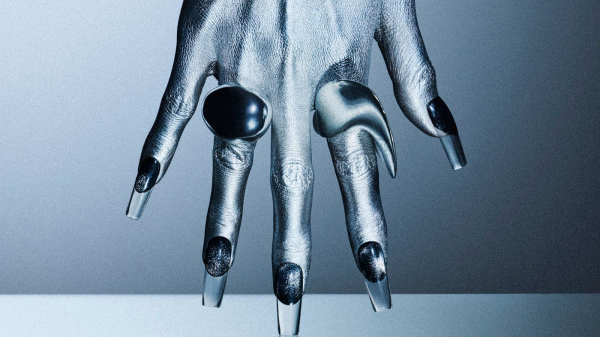
You see, the cat-eye manicure doesn’t get its velvety finish from magic. It’s thanks to microscopic metallic particles embedded in the polish, which are then manipulated with a magnet to create “depth, dimensional highlights, and a distinctive shimmering effect,” says Vikki Swan, a professional nail artist in Los Angeles. “Once the desired design is achieved, the gel is cured under a UV/LED lamp to lock the particles in place.” The gel polish first took off in Korea and has made its way into nail salons across the United States.
According to the American College of Radiology’s 2026 Manual on MR Safety, any individual undergoing an MR procedure must remove all readily removable metallic personal belongings and devices. This includes devices like hearing aids and insulin pumps, as well as watches, jewelry, and body piercings. While the manual doesn’t specifically mention metallic or cat-eye nail polish, it does say to remove any cosmetics containing metallic particles and lists eye makeup, magnetic eyelashes, and hair products (some extensions and dyes may contain metallic particles).
Now, why would a simple sparkly manicure prevent someone from undergoing an MRI? While the scanner is noninvasive, MRIs use powerful magnets and computer-generated radio waves that interact with the molecules inside your body to produce images. Metal—any amount—is prohibited from entering the cylindrical tube where the scan takes place. Larger metal pieces can physically move and become projectiles, while smaller particles have the ability to heat up, potentially causing burns. Metal also causes image distortion.
If you do end up accidentally slipping into an MRI machine with a cat-eye manicure, it won’t be like you’re a doomed actor in Final Destination. Your nails won’t necessarily rip off your fingers and go flying into the heart of the machine, and they (hopefully) won’t explode into balls of fire, either.
“There is the potential risk of getting a burn, but the bigger issue is actually the way that it can interfere with the imagery,” says Kristin Purcell, DO, a board-certified emergency medicine physician in Colorado. “The entire reason you’re getting an MRI is that we want to get a very sensitive picture of something—whether that's somebody who's had a stroke or a ligamentous injury or osteomyelitis (a bone infection)—so we really want to make sure that that imagery is detailed and correct because otherwise the iron oxide can distort the imagery and create a shadow.” Dr. Purcell works in the ER, and the patients she’s sending for MRIs are going to have them, regardless of the manicure they have on that day.
The guidelines preventing individuals from getting into an MRI machine with a trendy metallic mani are more of a precautionary measure than a life-saving one. “Because it's on your fingers, it's unlikely to cause a severe problem," says Alexander McKinney, MD, director of radiology at the University of Miami Health System. He notes that weaker magnets can be used in these situations to reduce the possibility of adverse reactions. If you do happen to be getting an MRI with a cat-eye mani, Dr. McKinney says to let your doctors know if you experience any heating in the area as a precaution.
In emergency situations, the manicure can be filed off, but the best and safest way is to have it removed by a nail tech, according to Viktoriia Voloshnya, a professional nail artist in Beverly Hills. In Anbouba’s case, she was able to reschedule her MRI for after her next nail appointment. She ditched the fancy, eye-catching polish and went for a single coat of OPI’s Put It In Neutral, just to be safe.